Generative AI and the Reorganization of Work
Generative AI and the Reorganization of Work
Public discussion about AI and employment often collapses into a single question: how many jobs will be lost? That framing is too narrow. A more serious concern is how AI changes the structure of work before full automation ever arrives. Systems that summarize, draft, classify, monitor, and recommend can reshape jobs by breaking them into smaller measurable tasks, increasing surveillance, and shifting discretion away from workers. Even when a role survives, it may survive in a thinner, more controlled form. The most credible evidence on this point comes from looking at multiple sources together: labor-exposure estimates, macroeconomic risk assessments, and workplace studies that show both gains and tradeoffs.
Recent labor data shows why this deserves attention. In May 2025, the International Labour Organization and NASK released a global index estimating exposure to generative AI. Their report found that 25% of jobs worldwide are potentially exposed to generative AI, and the share rises to 34% in high-income countries. It also found a strong gender imbalance in the most automation-prone categories: in high-income countries, jobs at the highest level of exposure account for 9.6% of female employment, compared with 3.5% of male employment. Clerical and administrative work appears especially exposed because these jobs often involve text production, information routing, scheduling, and standardized communication, exactly the kinds of tasks that generative systems can partially absorb.
The IMF’s 2024 discussion note on GenAI reaches a compatible but slightly broader conclusion. It argues that advanced economies will face both the benefits and the pitfalls of AI sooner, because their labor markets contain more cognitive and office-intensive work. It also highlights a recurring pattern: women and college-educated workers are often more exposed, older workers may find adaptation harder, and labor-income inequality may increase if AI complements already high-income workers more strongly than everyone else. That framing matters because it moves the discussion beyond simple substitution. The issue is not only whether tasks can be automated, but also who is positioned to capture the productivity gains.
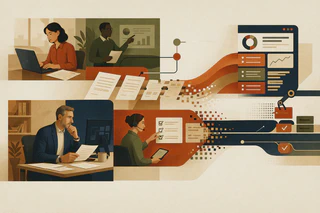
The important point is that exposure is not identical to replacement. In fact, the ILO explicitly argues that transformation is more likely than outright job destruction in many sectors. That is an important qualification, and it should not be ignored. But transformation still matters because employers can use AI to reorganize labor markets. If a system handles the first draft, the initial screening, or the routine client response, management may reduce staffing, flatten pay scales, or demand more output per worker. Workers may be told they are now “AI-assisted,” while the real effect is tighter oversight and weaker autonomy. In professional settings, AI can also shift judgment upward: junior workers lose formative tasks, middle managers rely more heavily on dashboards, and decision-making concentrates in fewer hands.
This is especially important in education, media, translation, customer support, and office administration. Imagine a school system adopting AI-generated lesson materials, feedback drafts, and parent communication templates. The teacher is still present, but the role changes. Some work becomes faster; some professional discretion gets narrowed; some evaluation becomes standardized around what the system can easily measure. That is not a clean story of job destruction or productivity gain. It is a redistribution of control over work.
The OECD adds another useful perspective here because it documents real workplace experiences rather than only exposure forecasts. Its Employment Outlook reports that over 80% of workers who work with AI reported higher job performance, and it cites experiments where generative AI improved output for customer support staff and programmers, often helping the least experienced workers the most. But the same OECD material also warns that outcomes differ sharply across worker groups: those who develop or manage AI often report the most positive effects, while workers subject to algorithmic management or using AI under closer monitoring report less positive job-quality outcomes. That split is exactly why this topic is ethical rather than merely technical. The same technology can improve productivity while worsening autonomy, bargaining power, or workplace pressure.
The ethical issue, then, is not whether society should “accept innovation.” It is whether institutions deploying AI are willing to account for who bears the adjustment cost. If AI improves output while making labor more insecure, more surveilled, or more unequal, then the gains are not being shared fairly. Claims about efficiency should therefore be evaluated together with questions about retraining, worker voice, transition planning, and whether automation is being used to support professionals or weaken them.
AI policy that looks only at productivity will miss this. The better standard is to ask what kind of work is being created, what kind is being hollowed out, and who has power over the new workflow. Read together, the ILO, IMF, and OECD sources suggest a sober conclusion: generative AI is unlikely to produce one uniform labor outcome. It will augment some workers, displace some tasks, and redistribute control unevenly. That is precisely why governance, labor protections, and institutional design matter.
Sources
- International Labour Organization and NASK. “One in four jobs worldwide are potentially exposed to generative AI.” 20 May 2025. https://www.ilo.org/resource/news/one-four-jobs-risk-being-transformed-genai-new-ilo%E2%80%93nask-global-index-shows
- International Labour Organization. Generative AI and Jobs: A Refined Global Index of Occupational Exposure. 2025. https://www.ilo.org/publications/generative-ai-and-jobs-refined-global-index-occupational-exposure
- IMF. Gen-AI: Artificial Intelligence and the Future of Work. January 2024. https://www.imf.org/en/Publications/Staff-Discussion-Notes/Issues/2024/01/14/Gen-AI-Artificial-Intelligence-and-the-Future-of-Work-542379
- OECD. Employment Outlook 2023, chapter “Artificial intelligence, job quality and inclusiveness.” https://www.oecd.org/en/publications/oecd-employment-outlook-2023_08785bba-en/full-report/artificial-intelligence-job-quality-and-inclusiveness_a713d0ad.html
